


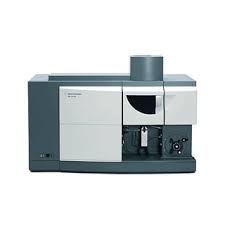
Inductively Coupled Plasma spectroscopy is a very sensitive atomic spectroscopy method where atomization occurs in an extremely hot plasma field. Compared to other methods, it has better detection limits, higher repeatability, and a higher dynamic range. ICP is widely used for the elemental analysis of most elements, except argon, which is the inert gas used to form the plasma.
A plasma is a high-energy mixture of electrons and positively charged ions; although there are lots of charged particles in the plasma, the total of the electrical charges is close to neutral. Unlike flame-based techniques, ICP offers more complete atomization and has very low chemical interferences. The presence of a large number of free electrons in plasma also reduces the disturbance caused by ionization. There is also a significant benefit from atomization in a chemically inert environment, without analyte oxidation, which enhances signal stability and sensitivity. Problems common to spark, arc, or flame methods, such as self-absorption and self-reversal, are overcome to a large degree due to the uniform temperature distribution in the plasma. This uniformity provides a greater linear range of detection and improves the overall analytical performance.
Spectroscopy
Inductively Coupled Plasma (ICP)
16
Feb
Feb
